
       Since the formation of the political spectrum, liberalism and conservatism have existed on opposite ends. Where liberalism places emphasis on equality over the law as well as social freedom, conservatism places value on tradition and maintenance of societal status quos. At their core, however, the two political beliefs hold many common tenets. For example, both groups hold the concepts of individual freedom and free enterprise in high regard. Atwood subtly addresses these similarities to make a larger point. In her novel The Handmaid's Tale, Atwood criticizes the hypocrisy inherent within the paradigms of extreme conservative and liberal ideologies to make an argument for the necessity of centrism, or moderate political views neither left nor right-leaning, for social harmony.
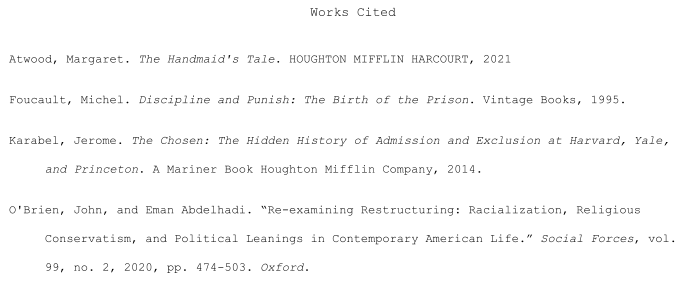
	Most notably, Atwood satirizes and subverts popular conservative talking points as a way to showcase the hypocrisy inherent within the right. In the 1980s, sociologist Robert Wunthow examined the relationship between religion and political affiliations in post-war American society. He found that stricter interpretations of religious doctrines correlated with a subscription to the Republican Party and right-leaning politics at large (O’Brien 2020). From the novel’s epigraph with Rachel and Billah, Atwood makes it clear that she agrees with and adheres to Wunthow’s assessment. Gilead plays heavily on religious tropes in multiple forms, from Gilead’s justification for handmaids through the Rachel and Bilhah story to innocuous details such as one of Gilead’s stores being named Loaves and Fishes after one of the Bible’s parables. Though Gilead may draw inspiration from the Bible, however, it also distorts the text as it sees fit. At one point in the novel, Offred says that the handmaids “...prayed for...emptiness, so we would be worthy to be filled: with grace, with love, with self-denial, semen and babies" (194). While most Christian doctrines include aspirations for an abundance of heavenly grace, Gilead adds to the prayer with their own definition of filling. This distortion of biblical doctrines is reminiscent of the way in which conservatives in the nineteenth century would omit parts of the Bible to create a justification for slavery. By paralleling the two practices, Atwood calls into question the validity of a political group under which such a paradox can exist.
	While Atwood clearly discusses the hypocrisy and pitfalls of Gilead’s conservative ruling class, she also makes a point to highlight the ways in which extreme conservative and liberal beliefs intersect. Offred’s mother is perhaps utilized the most to highlight these similarities. From her introduction towards the beginning of the novel, Atwood asserts that Offred’s mother directly opposes Gilead’s views. Beyond being an outspoken feminist, she asserts that a man’s only use is "..for ten seconds' worth of half babies. A man is just a woman's strategy for making other women" (121). Though Offred’s mother falls in line with the traditional definition of liberalism, her beliefs align with that of Gilead’s in terms of using one group of people to fulfill their own purposes.
	While Atwood relies on the narrative development of liberal characters to showcase the pitfalls of extreme left-wing views, she also uses facets of Gileadean society to emphasize the lack of division between the two extremist beliefs. For example, Atwood describes the Wall at Harvard University as “hundreds of years old too; or over a hundred, at least” with “gates [that] have sentries'' and “…ugly new floodlights mounted on the metal posts above it, and barbed wire along the bottom and broken glass set in concrete along the top” (31). On the surface, Atwood seems to be highlighting the depth of which right-wing politics has penetrated larger society, turning this prominent liberal arts university into yet another tool of a harsh police state. Despite its liberal arts background, however, Harvard has a long history of exclusionary policies, such as devising the modern college admissions cycle in the early twentieth century with quotas based on a variety of factors and added elements such as teacher recommendations as a way to combat the rising number of incoming Jewish students (Karabel 2005). One could argue that the outside of the school now simply reflects Harvard’s core philosophies. At the Red Center, Aunt Lydia declares “There is more than one kind of freedom…Freedom to and freedom from. In the days of anarchy, it was freedom to. Now you are being given freedom from. Don't underrate it” (24). By intentionally leaving the phrase “freedom to” as it is without further explanation, Atwood implies that this freedom comes at the expense of others. Using Gilead to poke at the hypocrisy of liberalism, or perhaps showcasing the hidden liberal voice through the conservative voice, Atwood blurs the line between the two ideologies to show that they are one and the same.
	After criticizing both extreme liberal and conservative ideals, Atwood pushes the reader to consider the validity of centrism. Offred plays a crucial role in making this argument. Though Offred desired liberation, she never made any outwardly rebellious movements similar to Moira or Ofglen. Rather, she maintained the status quo, serving the role that she was given in society, living her life directly in the middle of the road. This idea is further reflected by elements around her, with the Commander even saying that “Better never means better for everyone... It always means worse, for some” (211). Atwood draws inspiration from one of philosopher Michael Foucault’s theories of power. Foucault asserts that power is not inherently static and, rather, it shifts forms from one body to the next (Focault 1995). While a move towards a society like the one Offred’s mother envisioned would have made life exponentially better for women, it would have ultimately subjugated men in the same way. Therefore, Atwood asserts, no extremist government can truly work in the public interest. Later on in the novel, Offred seems to idolize the moon, describing it as “...a wishing moon, a sliver of ancient rock, a goddess, a wink” (97). The phrase “a goddess” coerces the author to think of the moon as a feminine figure. As Offred glorifies the moonlight, it is worth noting that the moon reflects the sunlight, standing in opposition to the moon as a masculine figure. One cannot exist without the other, similar to the idea that to succeed, liberal and conservative ideologies must find a way to coexist.
       While liberalism and conservatism are not typically divided between men and women, for the purposes of the novel, Atwood pushes the reader to examine it as such. Offred is one of Atwood’s driving forces in the argument for centrism, a social harmony between both ends of the political spectrum. Whether or not Atwood is correct in her assertion that centrism is truly what is needed for society to excel is up to the reader.

Samantha Lowe is a graduating senior at PPCHS with a passion for literature. In addition to serving as co-president of the school’s NEHS chapter, she also won the school’s literary fair in the spoken word category with her poem, “The Crack of the Whip.” Though she plans on studying politics post-graduation, her love of the literary arts will continue to inspire her.
 theatala.org