
     Set amidst the dark trenches of World War I, Siegfried Sassoon’s sonnet “Dreamers” paints a moving picture of the mental and physical battles faced by soldiers at war, using his own experiences as a backdrop. The poet weaves a narrative that switches between the horrific realities of conflict and soldiers’ inner yearnings. In contrast to the luxuries and desires craved by ordinary citizens, Sassoon reveals how soldiers long for previously mundane daily experiences. He poignantly juxtaposes the grim realities of the battlefield with familiar comforts like the monotony of work. Through evocative imagery and a structured form that eventually breaks, he conveys the unique nature of soldiers’ current experiences and their memories of their past lives. In “Dreamers,” the poet argues that even in the harshest conditions, human spirits cling to dreams and memories as a psychological coping mechanism and as a way to maintain humanity against the horrors of war.
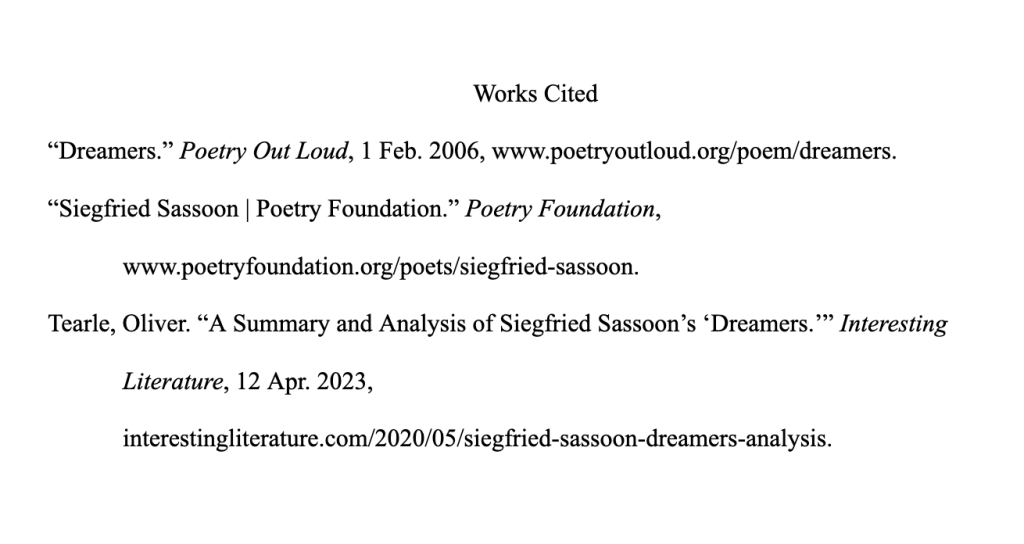
     In lines three through six, Sassoon first portrays war as fantasy-like. He utilizes phrases such as “great hour of destiny” (3) and “some flaming, fatal climax” (6) to highlight the idea of soldiers being sent to achieve something for the greater good, illustrating “war as a noble and heroic calling” (Tearle). They fight together, working to achieve a higher goal under the direction of supervisors and commanders. This seems to take the poem in a propagandistic direction, suggesting that soldiers’ efforts are valiant and courageous.
     However, lines six through eight quickly disable this idea by preceding a volta in line nine: a change in the poem’s message from propaganda and fantasy to a grim reality where soldiers can only dream. Sassoon himself shifted from a participant to a vocal critic of war. Soon after receiving an honor for “bringing back a wounded soldier during heavy fire, … [he] wrote an open letter of protest to the war department, refusing to fight any more” (“Siegfried Sassoon”). He then began to publish war poems, including “Dreamers.” Sassoon uses the lines “they must win … with their lives” (5 - 6) to explain how those in the military are essentially cannon fodder, sent to achieve victory at the cost of their own lives. Furthermore, clear juxtapositions emerge as Sassoon peels back the fantastical façade to express the dreams of those on the front line. He mentions “firelit homes, clean beds, and wives” (8). The juxtaposition of “flaming, fatal climax” (6) with “firelit” (8) shows the differences between soldiers’ realities and dreams -- the continuous fire of battle in a fiendish hellscape compared to the warmth and serenity of their homes. The poet’s use of alliteration within these phrases also draws attention to the dichotomy between conflict and peace found throughout the sonnet. Line nine, the beginning of the sestet, immediately delivers graphic imagery that further contrasts with language in the rest of the poem. Where the fighters once had “firelit homes” and “clean beds” (8), they now have “foul dug-outs” (9) and “the ruined trenches” (10) to live in. Accompanied just by comrades and rats, their miserable experiences only prolong their desperation for home; this longing is what allows them to continue fighting.
     The final four lines in the poem expand on the dream ideas introduced in the last two lines of the octave. Every soldier has dreams and aspirations -- dreams that do not involve agonizing combat. In line twelve, the phrase “mocked by hopeless longing” highlights the soldiers’ predicaments, as they are trapped in a never-ending cycle of terror. Sassoon portrays them as pawns, manipulated by commanders with no regard for the lost lives. When soldiers dissent, they are considered treasonous. In this way, soldiers are oppressed by their own superiors, as they are forced to fight. Still, their dreams persist, as their past experiences with “balls and bats” (11) and “picture shows” (13) evoke nostalgia and hope for a return to peace, helping them face their current situation.
     Unfortunately, for many soldiers, their last moments are in combat. The poet echoes this with the very final line of the poem. “Dreamers” ends almost in a fading manner; the polysyndeton in lines twelve through fourteen emphasizes the endless experiences taken for granted by soldiers before they went to war. While a conclusion that reiterates the message of the poem may be expected, Sassoon subverts this by ending the poem abruptly with the lines describing memories. On the battlefield, existence is fleeting, and the transition from life to death can be as swift as the transition from memory to reality. As a man dies, his dreams die with him.
     Sassoon uses this idea of soldiers’ existence throughout the poem, using aspects of form to make a point: “Dreamers” is a slightly modified English sonnet consisting of an octave and a sestet. With an ABABCDCD EFEFEF rhyme scheme, the poem mirrors the routine of soldiers’ daily experiences in war. Like the predictable repetition of AB, CD, and EF, a similar rhythm of hardship rules over these soldiers. This tight structure reflects the vicious cycle of pain, trauma, and despair that pervades their existence. However, the last two lines of the poem constitute a break from form; while a traditional English sonnet uses an ABABCDCD EFEFGG rhyme scheme, Sassoon opts to replace the final GG rhyming couplet with another EF. The intentional deviation reflects the unpredictability found in war. Just as a soldier’s life can shatter in an instant, the expected rhyme scheme also disintegrates rapidly.
     Based on Sassoon’s own experiences as a soldier and then an advocate for pacifism, “Dreamers” presents the turmoil of soldiers as people who are bound by duty yet long for peace. By comparing what is to what once was, Sassoon vividly captures loss -- that of loved ones, safety, comfort, and the simple things in life. Through moving contrasts, powerful imagery, and expert utilization of structure, he illustrates the traumatic nature of war while showing that even in the face of extreme adversity, humans will find means to persevere and stay resilient.

Nikhil Sangamkar is a graduating senior headed this fall to the University of Florida. “Exploring the Depths of Soldiers’ Psyches in “’Dreamers’” earned first place in the formal essay category of this year’s PPCHS Literary Fair.
 theatala.org