
As Louise Glück’s poetry collection The Wild Iris concludes, “The White Lilies” embodies an intimate and reflective denouement as the novel’s final piece. The triangulation of speakers in the book explores the relationship between humans, plants, and a deity. Glück’s decision to end her collection with the wisest of speakers, perennial lilies that can undergo rebirth, allows the reader to reflect on the human experience and psyche. Through the lens of an optimistic flower in the face of death, “The White Lilies” reveals how the battle of depression can be endured with self-love and acceptance despite the tribulations of human life.
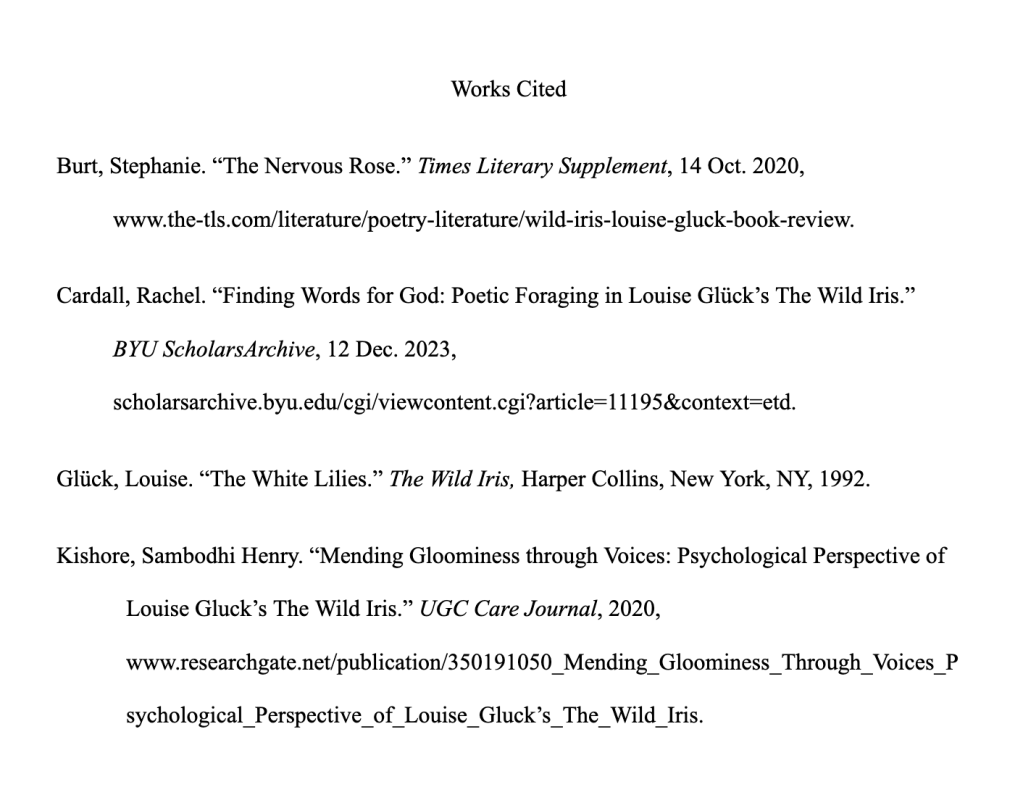
Glück uses the lily as the final speaker to present the poem from a reflective perspective whilst portraying hopeful human emotions. Glück utilizes the perennial flowers as a motif throughout the collection to emphasize the cyclical nature of birth, death, and rebirth which can parallel human emotion and behavior through depressive cycles. The perennial lily present in the poem is an ‘outside’ voice that can examine the “man and woman” (1) and their relationship in the “garden” (2). Though in reality, this lilies’ voice lacks sound and cannot be heard by the humans, it exclaims its thoughts to the reader, embodying a voice Glück utilizes to convey human sentiments. From a feminist approach, the flower speakers may parallel women whose romanticized dainty and delicate exteriors can shield inner hardship; as the woman gardener in the collection experiences hardship in her relationship with the man and God, bringing “terror” (6) to the garden, the flora in the collection also undergo suppressed tribulations: “Lamium” weeds lack sunlight buried beneath the shadows, and “Trillium” plants die to the summer sun earlier in the collection. This correlation establishes a connection between the flowers and the woman gardener. Stephanie Burt critiques the purpose of the flowers as speakers, believing they resemble “inevitable natural conditions— burial, resurrection, interdependence— explaining hard-to-grasp states of mind.” Rather than just human concepts however, these natural ideas are often emphasized when the human mind is plagued with depression, possibly allowing Glück to explore these emotions through different flowers that undergo their own hardships. For example, the poem opens with serene imagery, as the simile in the first two lines compares the garden to a “bed of stars” (3), suggesting a sense of romance from the gardener’s creation. In juxtaposition to this tranquil atmosphere, the white lily shifts to a melancholy tone which adds to a depressive mood, exclaiming in the first stanza that “all can be lost” (8-9) at the end of life, including the love hinted prior, reflecting a symptom of depression with feelings of ultimate despair. This is also represented through the speaker’s shift from soft, euphonious “r” and “s” sounds in words such as “stars,” “here,” (3) ‘linger,” and “summer” (4) to hard, cacophonous “c” sounds in words like “cold” (6), “could,” and “capable” (7) emphasizes how subtle interruptions emphasize how harsh mortality concepts can interrupt feelings of love. Unlike the other pessimistic and perennial flora, this speaker contemplates death in a similar manner to the Iris in the exposition of the novel; structurally, the poems begin dreary and close optimistically— a tone shift that Glück mirrors in both poems to begin and close her collection on a hopeful, reflective note.
The hopeful and optimistic tone after the volta resembles a new outlook for the human psyche, exploring a psychological perception of death. The first stanza ends abruptly with a dash, representing a quick deviation from depressive thoughts of mortality, potentially from the woman whose hardship connects to the many flora with their unheard voices and estranged relationships. The wise lily is able to provide solace, telling the gardener to “Hush, beloved” (13) to silence these negative and depressive thoughts. Glück juxtaposes the perennial nature of the lily to the human to show that despite the “summers [it lives] to return” (14), an optimistic outlook can make the gardener and lily have a similar end. Henry Kishare explores this connection psychologically, stating “the soul has no death so it is delighted to enter into the eternity of life,” therefore despite the flower’s rebirth, the human is similar because “every living creature…is created and destroyed but their souls remain unchanged.” This connects the lily and the gardener, who in “this summer…entered eternity” (15) together because of the comfort that life can go on past death not by spiritual ascendance, but by transcendence of the undying soul. Glück’s battle with depression is reflected through the human and floral speakers hardships by exploring topics of death and grief, and following a Jungian psychological explanation, the optimistic revelation in the final lines parallels personal growth between the conscious and unconscious mind, where the psyche develops through wisdom, as offered by the lily, and self-discovery, evident through the gardener. Alternatively, Rachel Cardall interprets this end mythologically, believing God offers solace as the speaker in the final stanza, believing if this comfort is a “metaphor [from] God,” that “God’s hush, after all the speaker’s prayers, is an assurance that he is nearby.” This would suggest the deity in the collection communicates to the gardener through the flora, yet this would connect the God and the human speakers immensely despite their disconnection and turbulent relationship throughout the novel. Thus instead, Glück may be trying to portray the opposite message, that a tenuous relationship with God paralleling one’s depressive relationship with the self can be “[Buried] … to release its splendor” (17) through self-discovery, as portrayed by the female gardener and the white lilies.
“The White Lilies” offers an optimistic conclusion through the journey of the human psyche to reach transcendence through self-discovery and acceptance. The collection begins with a door beyond death, but conclusively ends with a calming acceptance and release from tensions of mortality as the lilies and gardener accept emotional rebirth. Despite the tribulations visible in depressive relationships, Glück embraces comfort in the uncertainties of struggle, portraying through a sanguine end that the gardener, flora, and humans alike can find hope beyond despair.

Mia Felipe, a graduating senior at Pembroke Pines Charter High School, wrote this explication essay on “The White Lilies” as part of her AICE A-Level Literature studies, analyzing the poetic themes and style of Louise Glück’s The Wild Iris.

