
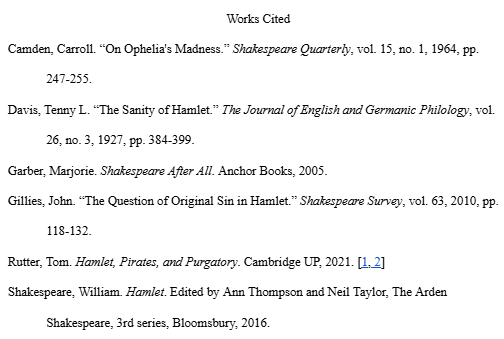
In the Elizabethan era dramatic tragedy Hamlet, playwright William Shakespeare explores how the reckoning force of corruption can influence the minds of those most susceptible to commit immoral acts under the guise of maintaining order. Upon the publication of the play, Shakespeare, according to historical critic Raymond MacDonald Alden, found himself in a society wrought with “transformation,” such as the religious context of the Protestant Reformation and the academic context of the Renaissance. Both of these two movements shape the audience’s understanding of the characters’ autonomy in the play, as Calvinists viewing Hamlet Sr.’s ghost would’ve viewed it as a “demon,” according to biographical critic Tom Rutter, implying the existence of divine fate, and as the general audience would’ve been surprised at Hamlet’s Enlightenment-era insistence on thinking to forge his own destiny. Thus, upon a close examination of the text, one can contend that Shakespeare acknowledges the inevitability of fate, while simultaneously illustrating how one’s free will can circumstantially autonomize their fate; the two characters who go ‘mad,’ Hamlet and Ophelia, are portrayed to be using their free will against societal norms and are thus able to tell their own stories. Via dramatic irony and the play’s structure, Shakespeare’s audience experiences how thought can free oneself from the constraints of their environment, or fate.

From the opening scene of the play, featuring the Ghost, the audience understands that fate has a material, guiding presence over the narrative. From the mythological perspective, this becomes especially prevalent due to the play’s Calvinist backdrop, which compels the audience to believe solely in the fate of life or death and the absence of purgatory. For example, the Stratford Festival’s production of the play contains frequent religious imagery, such as the large cross brandished over the stage, Polonius’ rosary, or the church bells that close some particular scenes. Thematically, the symbolic presence of the cross implies that death, otherwise referred to as fate, looms over Denmark constantly. Mythological critic John Gillies corroborates this idea, connecting Hamlet’s background at “Wittenburg” to the prince’s “divine imputation” by the Ghost to commit the murder. However, this play is one of subversion; for one, the Ghost’s very existence implies the older, Catholic doctrine to be reality, in which one possesses the added layer of free will permitted by purgatory. Gillies, despite enumerating the fact that the social zeitgeist in Denmark leaned Protestant, also contends that the prince’s tone is “hardly pious,” suggesting that he has split from the Calvinist doctrine of fate using his free will. A third subversion of religious fate is found in Act 3, Scene 3, in which the impious “satyr” Claudius attempts to pray using his weak connection to God, but the free will of his thoughts cause them to “remain below.”

Shakespeare, through the inclusion of different genders’ reactions to the dichotomy between fate and free will, takes a feminist perspective on what it entails to truly be free. Throughout the play, Hamlet’s ‘madness,’ although dramatic irony employs the audience to know the reality of the situation, is questioned but permitted in the patriarchal society of Denmark; however, Ophelia’s madness is portrayed much more seriously and much shorter-lived, reflecting the limited freedoms of women during the Elizabethan era. Gender critic Carroll Camden employs two varying perspectives on the matter, as she first contends that the play’s women completely lack free will, citing Polonius’ “prescription” to Ophelia to stay away from Hamlet. However, via a tragic “species of irony,” it is this command which seemingly causes Hamlet’s ‘madness,’ ultimately leading to Ophelia’s actual madness. Therefore, Camden argues that the suppression of women’s free will eventually causes them to embrace their freedom.

When Ophelia recites that “the owl was the baker’s daughter,” her newly freed mind contends that the permanence of fate eventually implicates the expression of free will, which is symbolized by the transformation within the parable. Additionally, the play’s intentionally-described secondhand account of Ophelia’s fate reflects the freedom that she possessed even in death, not being restricted to the playwright’s stage directions of her death had it been shown. Another character implicated in this gendered criticism is Gertrude, who is nigh-omnipresently puppeteered by Claudius, Polonius, and the other males in the tragedy who weaponize her “frailty,” but she ultimately meets her demise through an expression of free will; in an exhibition of dramatic irony, Gertrude’s first true act of defiance against the men in her life, when she willfully drank the poisoned chalice, forces her to meet her fate. For the period, Shakespeare made a heavy statement on the nature of gender dynamics by allowing men to utilize their free will to commit murder, while the women used it to commit suicide.

By the play’s entrance into its final act, Shakespeare has illustrated the certainty of fate and the procrastination of free will. Through illusions to “Alexander” the Great and the mountain “Pelion,” Hamlet understands that death, as sociological critic Marjorie Garber puts it, is part of a “triangle” of inevitabilities, but that one still possesses the ability to shape their death. Precisely before the final scene of the play, Hamlet declares to Horatio that people can “defy augury,” giving into fate to accept his imminent doom. However, the alternative perspective contends that he utilizes his free will, commanding his thoughts to be “bloody” to ensure that his death meant the demise of all the other royals and important nobles. Hamlet’s thinking, in the eyes of psychological critic Tenney L. Davis, forges not his weak, inability to act, but his strong “malfunction of decorum” against fate and those who oppose him. Ultimately, when a society “depreciates” the ability to think (pre-Enlightenment), it is those who conduct “logic-chopping” who appear insane when they are more in control of their fate and free will than anyone else.

Jonathan Alonzo is a graduating senior from Pembroke Pines Charter High School’s Class of 2026. This piece of literary criticism concerns William Shakespeare’s dramatic tragedy Hamlet, as assigned by the curriculum for the AICE A-Level English Literature course.
 theatala.org